Modeling the processes of vibration compaction of casting molds taking into account the effect of asymmetry of friction forces
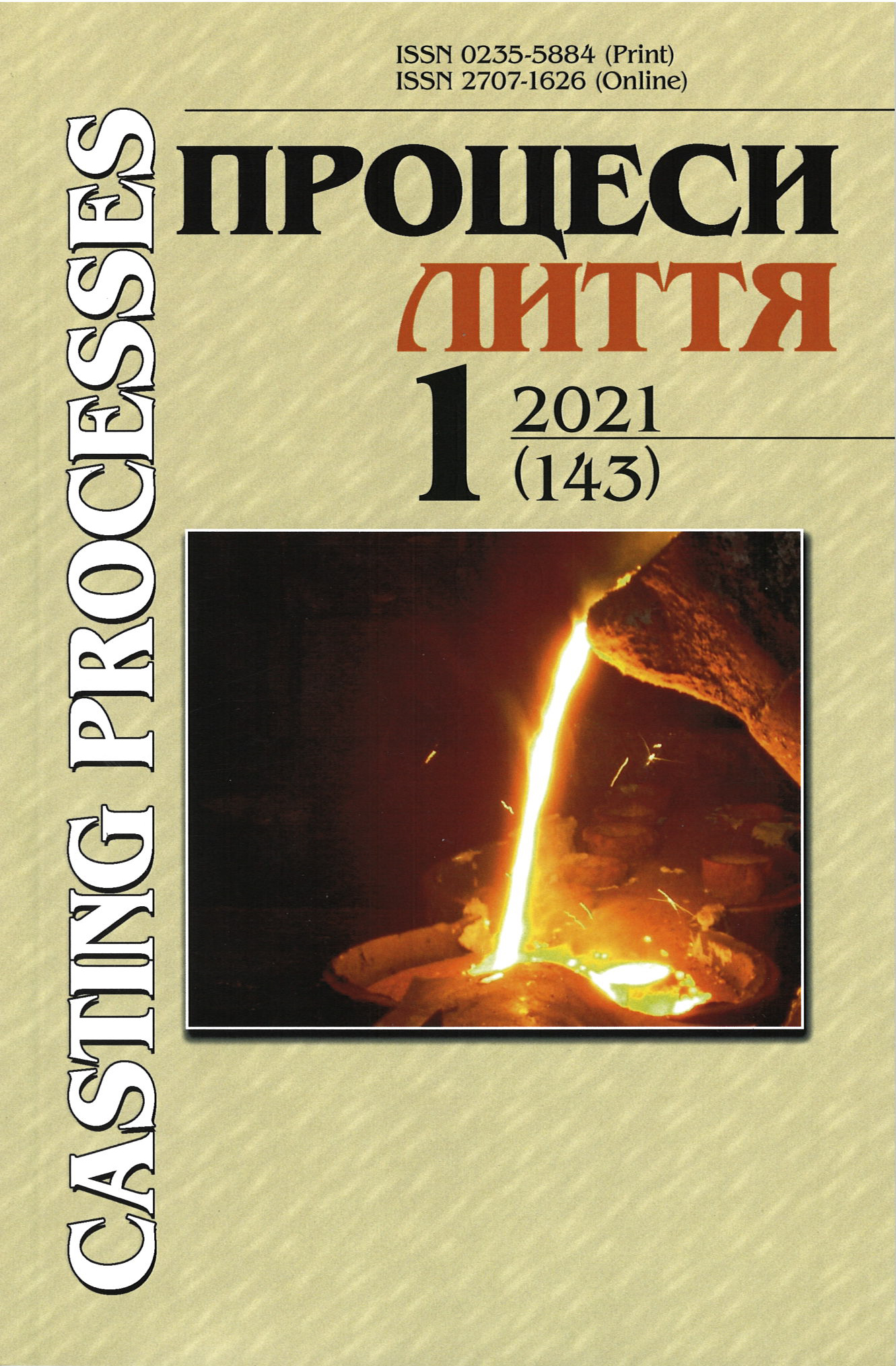
Processy litʹâ, 2021, Tom 143, №1, p.43-49
DOI:
https://doi.org/10.15407/plit2021.01.043Keywords:
The sand mold, molding sand, vibrating seal, asymmetry of frictional forcesAbstract
Received 10.12.2020
UDK 621.744.362
The purpose of the work is to create a scientific basis for modeling and analysis of the interaction of the sand molding mixture with the elements of the mold in the process of vertical excitation of vibrations of the mold. Under the influence of external vibration forces in the mixture there is an alternating stress-strain state, there is a destruction of the primary structural bonds and weakens the bonds between its individual elements, the final movements of mineral particles with the formation
of denser packaging. In the process of physical modeling the peculiarities of excitation of the effect of asymmetry of frictional forces at vibration consolidation of molds are revealed. Experimental data have been obtained to determine the law of increasing density of the medium and the duration of vibration influence depending on the parameters of the asymmetry of frictional forces. The general principles of construction of new designs of foundry forms taking into account asymmetry of frictional
forces are established. The design of a casting mold for casting hollow cylindrical castings is given.
The results of the work expand the idea of the technological process of vibration formation using the effect of asymmetry of frictional forces.
References
Nogovitsyn A. V., Baranov I. R., Nazarenko V. A., Mashkin A. M. ()2015 Physical modeling of melt flow during roll casting. Casting processes, no 4, pp. 69–73. [in Russian].
Nogovitsyn A. V., Baranov I. R. (2013) The method of calculating the length of the zones of crystallization and deformation during roll casting. Processing of metals by pressure, no 1 (34), pp. 170–176. [in Russian].
Nogovitsyn A. V., Podoltsev A. D., Curly I. N. (2015) Three-dimensional modeling of hydrodynamic processes in a two-roll mold with different methods of metal supply. Proceedings of the IER NASU. Issue. 40, pp. 95–102. [in Russian].
Analysis of Mold Filling in Lost Foam Casting of Aluminum: Part II-Example Applications (20090100) International Journal of Metalcasting, Vol. 3, Issue 1, Winter 2009, pp. 7–25. [in Russian].
Rusakov P. V. (2008) Method of forced migration compaction of forms with unbound filler in synchropulse control of vibration and gas vacuum. Proceedings of the IV International scientific-practical conference "CASTING – 2000". Pp. 131–132, March 25–27, Zaporozhye. [in Russian].
Rusakov P. V. (2010) Some general principles of dual control of the vibroforming process. Casting processes, no 4, pp. 36–45. [in Russian].
Patent US6457510 (B1) - 2002-10-01, ECLA: B22C15 / 10. Method for compacting molding sand.
Rusakov P. V. (2009) The method of vibroforming of bulk foundry molds with energy mapping of the dilatancy process. Metal and casting of Ukraine, no 4/5, pp. 12–17. [in Russian].
Avdokushin V. P. (2001) Choice of optimal modes of vibrocompaction of forms at molding on gasified models. Foundry production, no 4, pp. 38–40. [in Russian].
Rusakov P. V. (2009) Features of modeling of vibroforming machines with variable attached mass. Casting processes, no 3, pp. 35–42. [in Russian].
Rusakov P. V. and others. (2010) The method of measuring the pressure of sand in the mold. Sat. Promising technologies, materials and equipment in the foundry industry». Kiev, pp. 235–238. [in Russian].
Downloads
Published
How to Cite
Issue
Section
License
Copyright (c) 2021 О. В. Ноговіцин, П. В. Русаков, В. П. Школяренко, К. А. Сіренко

This work is licensed under a Creative Commons Attribution 4.0 International License.