Features of Rotary Processing of Aluminum Melts in the Ladle in the Rheo-Thixocasting Processes
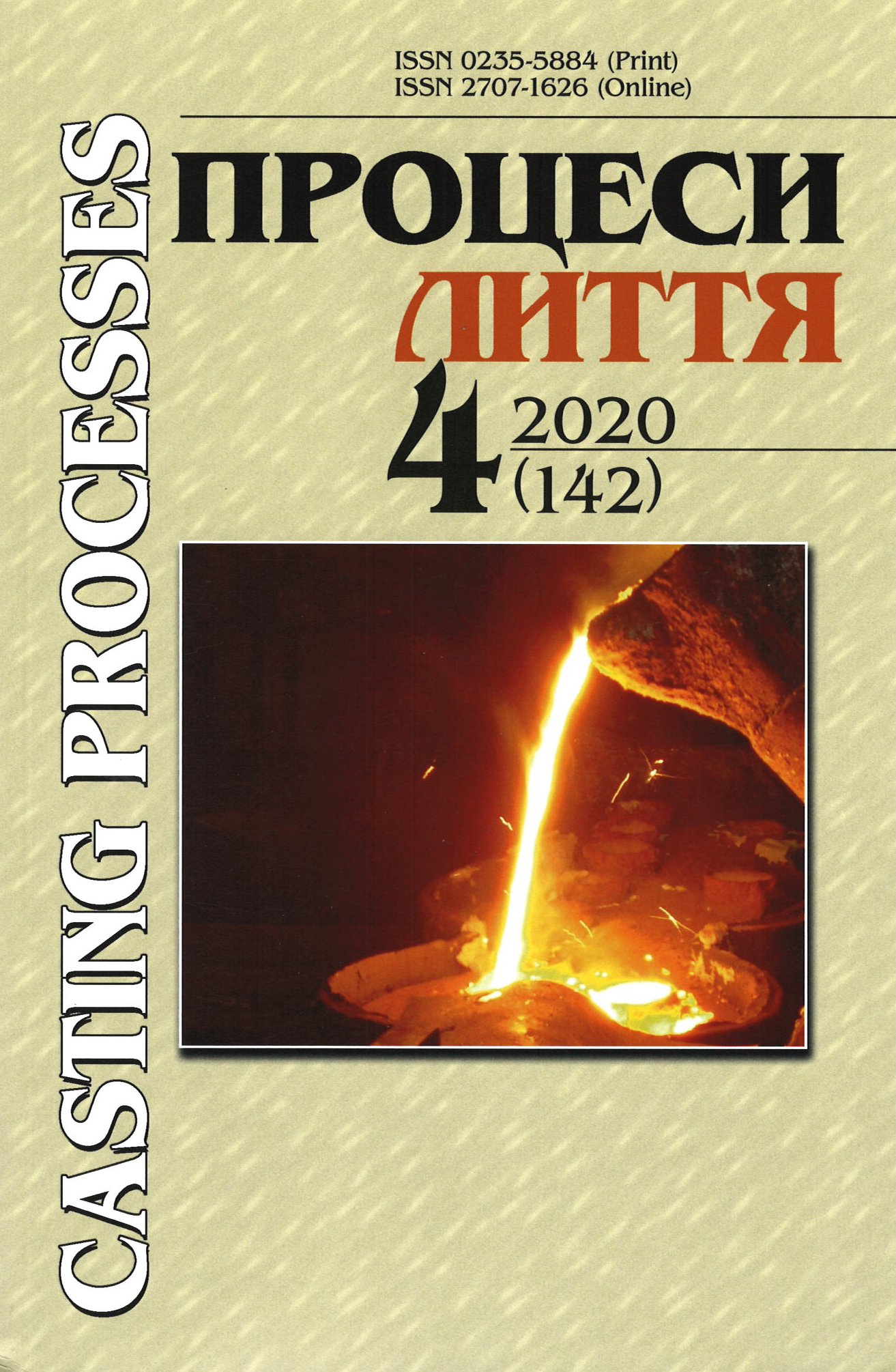
Processy litʹâ, 2020, Tom 142, №4, p.3-12
DOI:
https://doi.org/10.15407/plit2020.04.003Keywords:
rotary machining, rheo-thixocasting, aluminum alloys, hydro modelingAbstract
Received 12.05.2020
UDK 669.715:66.067
Features of rotary processing of aluminum melts in a ladle for the implementation of modern casting processes of rheo-thixocasting are given. It is shown that in the system "rotor - ladle with melt" there are twointerconnected surfaces that generate crystallization centers - the rotor and the ladle. Using the rmophysical formulas it is shown that the main criterion for the formation of crystallization centers is the supercooling of a melt in a precrystallization state. Features of the system are as follows: a rotor rotating undercools the layers of aluminum melt adjacent to it and stream direct them to the walls of the ladle, sweeping from them crystallization centers and microcrystals were formed and transport them into the volume of the melt. When rotor processing is carried out, microcrystals are set on the surface of the ladle, which, during the process of pouring the melt into the empty form in a turbulent regime, are then frozen into the volum. Thin films of aluminum oxide are constantly formed on the melt surface, its thickness depends on the exposure time and temperature. Rotary treatment of the melt in the active hydrodynamic upper zone of the ladle (h ~ 15-20 mm) routed aluminum oxide and submerged in the bulk melt, which can become the additional crystallization centers. Rotary processing of the melt in the upper active zone (h ~ 15–20 mm) agitates and destroys aluminum oxides in the melt volume, which can become additional crystallization centers. The freeze frame of the hydro-modeling of the rotary treatment process using gas-saturated (CO 2) water is given. The zone of uniform distribution of gas in the volume of the tank with water is fixed. Thus, a suspension with a solid phase is formed in the form of crystallization centers (microcrystals) of an α-solid solution of aluminum and iron intermetallics, which spontaneously formed above the liquidus line. It is shown that the rotary treatment of the melt in the pre-crystallization region of temperatures changes the process of crystallization of the galvanized intermetallics, and that the process of the crystallization of the intermetallic particles is reduced to the formation of some compact phases with a size of 10-15 microns to replace the dissolution. Spheroidization of α-solid size during rotary molding at temperatures close to liquidus is reduced to a change in grains, an increase in the plasticity of a grain in 3-5 times, as well as performance.
References
Patent of Ukraine No. 85981, publ. 03/10/09, Bull. No. 5. Thixolt method. Golovachenko V. P., Borisov G. P., Duka V. M. [in Russian].
Golovachenko V. P., Khvostenko I. V., Vernidub A. G. (2013) What gives rotary processing of aluminum melts in the precrystallization temperature range. Casting processes, 3, pp. 8–12 [in Russian].
Golovachenko V. P., Borisov G. P., Duka V. M., Baev S. A., Tsir T. G. (2013) Experimental-industrial verification of a new method of casting. Casting processes, 4, pp. 38–30 [in Russian].
Golovachenko V. P., Cir T. G., Duka V. M., Vernidub A. G., Isaicheva N. P. (2019) The advantages of casting partially hardened aluminum alloys (re-casting). Casting processes, 3, pp. 33–39 [in Russian].
Skrebtsov A. M. (2008) The temperature of the destruction of clusters of metal melt academician V. I. Arkharova or only the loss of hereditary properties of the mixture. Effect A. M. Skrebtsova. Casting processes, 5, pp. 9–15 [in Russian].
Balandin G .F. (1979) Fundamentals of the theory of the formation of castings. Part II. The formation of the microscopic structure of the casting. Moscow: Engineering. 335 p. [in Russian].
Mondolfo L .F. (1979) The structure and properties of aluminum alloys. Moscow: Metallurgy. 640 p. [in Russian].
Prigunova A. G., Belov N. A., Taran YU. N. and other (1996) Siluminy. Atlas mikrostruktur i fraktogramm promyshlennykh splavov. M.: MISIS, 175 p. [in Russian].
Stewart G. W. X-ray diffraction in water the nature of molecular association. Phys. Rew. 1931/- 37, No 1, pp. 9–21.
Baum B. A. Metallic liquids. Moscow: Nauka, 1979, 120 p. [in Russian].
Danilov V. I. (1971) The structure and crystallization of liquids. Moscow: Higher school. 256 p. [in Russian].
Frenkel Ya. I. (1975) Kinetic theory of liquids. Leningrad: Nauka. 392 p. [in Russian].
Golovachenko V. P., Isaicheva N. P., Vernidub A. G., Duka V. M., Tsir T .G., Shenevidko L. K. (2019) Environmentally friendly method of finishing refining of aluminum alloys. Casting processes, 5, pp. 11–16 [in Russian].
Downloads
Published
How to Cite
Issue
Section
License
Copyright (c) 2020 В. П. Головаченко, Л. К. Шеневідько, Н. П. Ісайчева, В. М. Дука, Т. Г. Цір, А. Г. Вернидуб

This work is licensed under a Creative Commons Attribution 4.0 International License.