Analysis of metal systems for developing creep-resistant aluminum alloys. A review
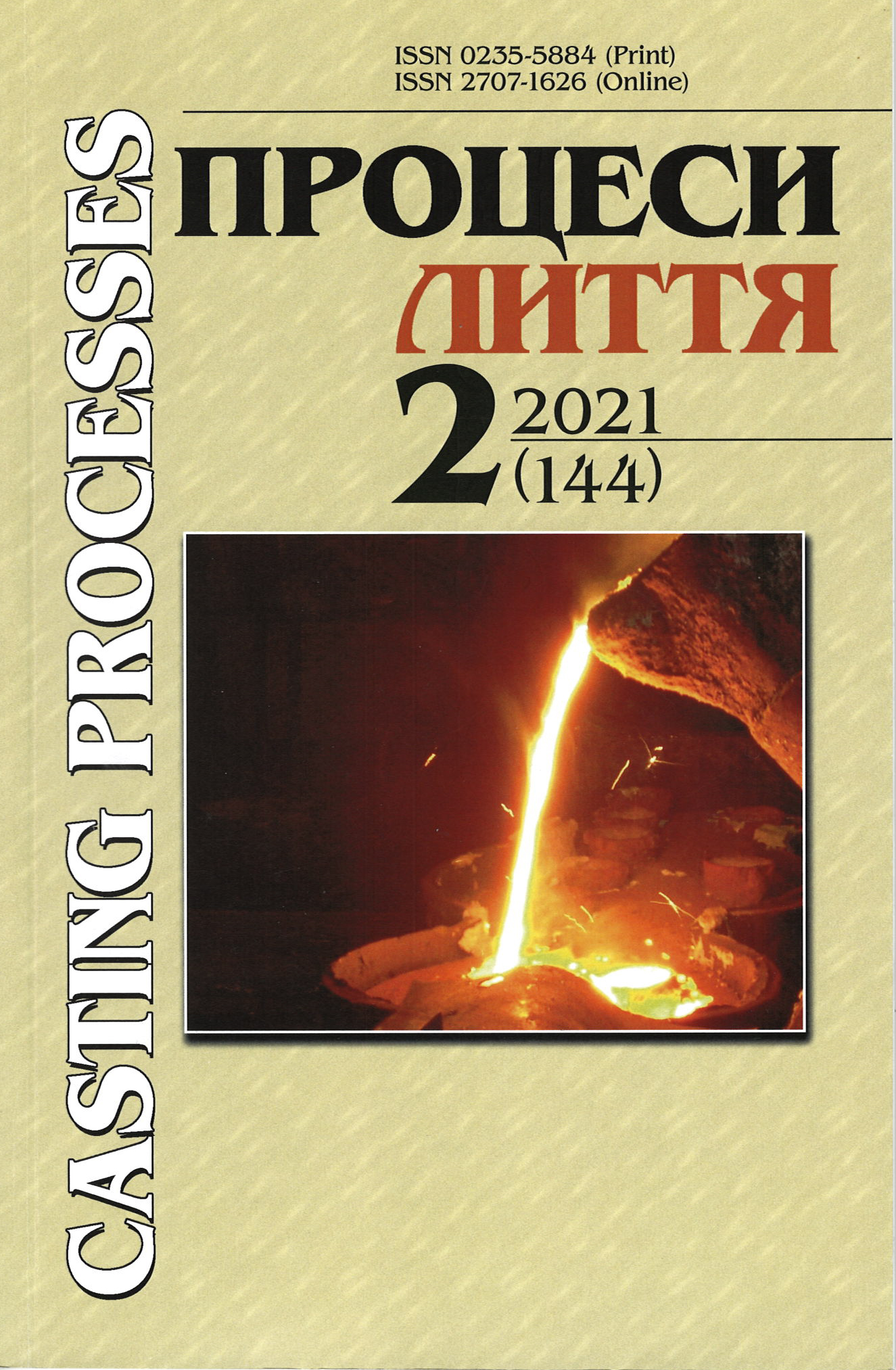
Processy litʹâ, 2021, Tom 144, №2, p.53-60
DOI:
https://doi.org/10.15407/plit2021.02.053Keywords:
material development, creap-resistant aluminum alloys, cast aluminum alloys, eutectic systemsAbstract
Received 28.04.2021
UDK 669.018.44:669.715
This article considers the role of the main alloying elements that have the most significant impact on the formation of aluminum alloys physical and mechanical properties for operation at high temperatures. Significant interest in research and prospects of casting compositions based mainly on eutectic systems and elements or compounds that can positively affect the structure and phase composition of alloys to increase their high temperature strength is shown. The analysis and comparison of the known systems Al–Si, Al–Cu, and Al–Mn with the systems Al–Fe, Al–Cr, Al–Ce, Al–Ni, Al–Ni–La, and others potentially suitable for creation of creap-resistant compositions are reviewed. Peculiarities of the structural-phase state, physical and mechanical characteristics of binary aluminum alloys, and the influence of the considered components on these indicators, depending on their content alloys obtaining conditions are considered. It is noted that the eutectic system Al–Ca, despite some similarities with other considered systems, does not meet the necessary requirements for the creation of alloys, operating at elevated temperatures. However, experimental cast alloys of this system are characterized by high specific strength and ductility. The following trends in the development of heat-resistant aluminum alloys have been identified: the use of almost insoluble elements and elements with a low diffusion coefficient in aluminum; creation of eutectic type complex-alloyed multicomponent alloys; creation of rapidly crystallized multicomponent alloys, which are subjected to further pressing and sintering. The development of cast alloys of Al–Fe– Mn–Ni, Al–Fe–Cr–Mn–Ni, and Al–Ni–La systems with nanostructured thermally stable eutectic deserves special attention and seems to be the main trend in reviewed question. The need for research related to microalloying and modification of such alloys is indicated.
References
Zolotarevskyi V. S., Belov N. A. (2005). Metalscience of cast aluminum alloys. M.: МISIS. 376 p. [In Russian].
Knipling K. E., Dunand D. C., Seidman D. N. (2006). Creteria for development castable, creep- resistant aluminium-based alloys – A review. Z. Metallkd. No. 97. Pp. 246–265.
Mondolfo L. F. (1979). Aluminum alloys: Structure and properties. London; Boston: Butter- worths. 971 p.
Kaufman J. G. (2016). Fire resistance of aluminum alloys and measuring the effects of fire ex- posure on the properties of aluminum alloys. – ASM international. 138 P.
Kolachev B. A., Elagin V. I., Livanov V. A. (2005). Metalscience and thermal treatment of non-fer- rous metals and alloys. М.: MISIS. 432 p. [In Russian].
Molina R., Amalberto P., Rosso M. (2011). Mechanical characterization of aluminium alloys for high temperature applications. Part 2: Al–Si–Cu alloys. Metallurgical science and technology. Vol. 29-2. Pp. 5–13.
Girgis A., Samuel A. M., Doty H. W., Valtierra S., Samuel F. H. (2019). Properties of Al–Cu Cast Alloys: Role of Heat Treatment. Advances in Materials Science and Engineering. Article ID 8247914. P. 15. https://doi.org/10.1155/2019/8247914
Rakhmanov J., Timelli G., Bonollo F. (2016). The effect transition elements on high-temperature mechanical properties of Al–Si foundry alloys – A review. Advanced engineering materials. No. 7. Pp. 1096–1105.
Taran Yu. N., Mazur V. I. (1978). Structure of eutectic alloys. М.: Metalurgiia, 312 p. [In Russian].
Liakishev N. P., Bannih О. А., Rokhlin L. L. et al. (1996). Phase diagrams of binary metal systems: Handbook. vol. 1. Edited by Liakishev N. P. М.: Mashinostroenie, 992 p. [In Russian].
Stadler F. et al. (2012). Effect of main alloying elements on strength of Al–Si foundry alloys at elevated temperatures. International Journal of Cast Metals Research. Vol. 25. No. 4. pp. 245–224.
Kumar K. S. (1990). Ternary intermetallics in aluminium refractory-metal X systems (X = V, Cr, Mn, Fe, Co, Ni, Cu, Zn). Intermetallic Materials Review. No. 35 (6). Pp. 293–327.
Rana R. S., Rajesh Purohit, Das S. (2012). Reviews on the Influences of Alloying elements on the Microstructure and Mechanical Properties of Aluminum Alloys and Aluminum Alloy Com- posites. International Journal of Scientific and Research Publications. Vol. 2, Issue 6. Pp. 1–7.
Gao Y. H. et al. (2019). Stabilizing nanoprecipitates in Al-Cu alloys for creep resistance at 300 0C. Materials Research Letters. Vol. 7, Issue 1. Pp. 18–25.
Vojtech D. (2010). Challenges for research and development of new aluminum alloys. MET- ALURGIJA. No. 49 (3). Pp. 181–185.
Czerwinski F. (2020). Thermal Stability of Aluminum Alloys – A Review. Materials. No. 13 (15). Pp. 1–49.
Martinez-Sanchez R. et al. (2016). Evolution of Microstructure in Al–Si–Cu System Modified with a Transition Element Addition and its Effect on Hardness. Materials research. Vol.19. Supl. 1. pp. 59–66.
Kuchariková, L.; Liptáková, T.; Tillová, E.; Kajánek, D.; Schmidová, E. (2018). Role of Chemical Composition in Corrosion of Aluminum Alloys. Metals, no. 8, рр. 581–594.
Elagin V. I. (2007). Ways of development of high-strength and heat-resistant structural aluminum alloys in the XXI century. Metalscience and heat treatment of metals. No. 9. Pp. 3–11. [In Russian].
Gupta, A. K. et al. (1996). Review of the techniques for the extraction of second-phase particles from aluminum alloys. Materials Characterization. No. 37. Pp. 61–80.
Rylands L. M., Wilkes D. M. J., Rainforth W. M., Jones H. (2004). Coarsening of precipitates and dispersoids in aluminium alloy matrices: a consolidation of the available experimental data. Journal of Materials Science. Vol. 29. Pp. 1895–1994.
Lyutova O. V., Volchok І. Р. (2008). Increase of foundry properties of secondary silumins. Ar- chives of foundry engineering. Vol. 8. Pр. 89–91.
Crepeau, P. N. (1995). Effect of iron in Al-Si alloys: a critical review. Transactions of the Amer- ican Foundryman’s Society. No. 103. Pp. 361–366.
Belov N. A., Alibin А. N. (2010). Promising aluminum alloys with increased heat resistance for valve construction as a possible alternative to steels and cast iron. Materials in mechanical engineering. No. 2 (65). Pp. 50–54. [In Russian].
Richard Rajan, Paul Kah, Belinga Mvola, Jukka Martikainen. (2016). Trends in aluminium alloy development and their joining methods. Reviews on Materials Science. No. 4 (44). Pp. 383–397.
Hughes I. R., Jones H. (1977). Coupled eutectic growth in Al–Fe alloys Journal of Materials Science. Vol. 12, Issue. 2. Pр. 323–333.
Fuxiao Yu., Fang L., Dazhi Zh., Toth L. S. Microstructure and mechanical properties of Al–3Fe alloy processed by equal channel angular extrusion. 2014. IOP Conference Series Materials Science and Engineering, vol. 63. pp. 1-6. DOI: 10.1088/1757-899X/63/1/012079
Zhou P. et al. (2021). New Strategy to Improve the Mechanical Properties in Cast Al–Mg–Fe Alloys by the Formation of Al–Al–Fe Eutectic. Advanced engineering materials. https://doi. org/10.1002/adem.202001460
Wang X., Guan R. G., Wang Y. (2018). Formation Mechanism of Nanoscale Al3Fe Phase in Al- Fe Alloy During Semisolid Forming Process. Metal Mater Trans B. Vol. 49. pp. 2225–2231. https://doi.org/10.1007/s11663-018-1323-7
Loza K. N., Mitiaev А. А., Volchok Ch. P., Lukinov V. V. (2011). Improving the quality of the piston alloy AL25. Engine Building Bulletin. No. 1. Pp. 138–143. [In Russian]
Yamasaki S. et al. (2019). Effect of Fe Addition on Heat-Resistant Aluminum Alloys Produced by Selective Laser Melting. Metals, vol. 9(4), 468; https://doi.org/10.3390/met9040468
Rajabi, M.; Vahidi, M.; Simchi, A.; Davami, P. (2009). Effect of rapid solidification on the micro- structure and mechanical properties of hot-pressed Al–20Si–5Fe alloys. Mater. Charact, vol. 60. Pp. 1370–1381.
Ma, P.; Jia, Y.; Prashanth, K. G.; Scudino, S.; Yu, Z.; Eckert, J. (2016). Microstructure and phase formation in Al–20Si–5Fe–3Cu–1Mg synthesized by selective laser melting. J. Alloys Compd., 657, 430–435. 34. Prusa, F.; Vojtech, D. (2013). Mechanical properties and thermal stability of Al–23Si–8Fe–1Cr and Al–23Si–8Fe–5Mn alloys prepared by powder metallurgy. Mater. Sci. Eng. A. Vol. 565. Pp. 13–20.
Massalski T. B. and Okamoto H. (1986). Binary alloy phase diagrams, Vol. 1, ASM International, Ohio. 140 p.
Molina R., Amalberto P., Rosso M. (2011). Mechanical characterization of aluminium alloys for high temperature applications. Part 1: Al-Si-Cu alloys. Metallurgical science and technol- ogy. Vol. 29-1. Pp. 5–15.
Kovalevskaya T. A., Daneiko O. I, Kulaeva N. A., Kolupaeva S. N. (2015). Plastic behavior of heterophase alloys with an fcc matrix reinforced with particles with the L12 superstructure. Proceedings of universities. Physics. Vol. 58. No. 3. Pp. 52–57. [In Russian].
Daneiko O. I, Kulaeva N. A., Kovalevskaya T. A. (2016). Mathematical modeling of strain harden- ing of heterophase alloys with a second phase having an L12 superstructure. Bulletin of the Tambov University. Series: Natural and technical sciences. Vol. 21. No. 3. Physics, pp. 952- 955. [In Russian].
Zusin V. Ya., Serenko V. A. (2004). Welding and surfacing of aluminum and its alloys. Mariupol: Renata. 468 p. [In Russian].
Luts A. R., Suslina А. А. (2013). Aluminum and its alloys: Tutorial. Samara: SGTU. 81 p. [In Russian].
Sfikas A. K., Lekatou A. G. (2020). Electrochemical Behavior of Al–Al9Co2 Alloys in Sulfuric Acid. Corros. Mater. Degrad. Vol. 1. Pp. 249–272.
Lekatou A., Sfikas A., Petsa Ch., Karantzalis A. (2016). Al–Co Alloys Prepared by Vacuum Arc Melting: Correlating Microstructure Evolution and Aqueous Corrosion Behavior with Co Con- tent. Metals. No. 6(3), 46. Pр. 1–23.
Vojtech D., Michalcová A., Novák P. (2008). Structural Evolution of Al–Cr Alloy during Processing. Solid State Phenomena. Vol. 138. Pp. 145–15.
Arjuna Rao A., Murty B. S., Chakraborty М. (1996). Response of an Al–Cr alloy towards grain refinement by Al–5Ti–1B master alloy. International Journal of Cast Metals Research. Vol. 9. Pр. 125–132.
Vojtech D. et al. (2008). Structure and properties of PM nano-crystaline Al–Cr based alloys. Materials science forum. Vol. 567–568. Pp. 197–200.
Almeida A., Vilar R. (2010). Al–Al7Cr eutectic in Al–Cr alloys synthesized by laser alloying. Scripta Materialia. Vol. 63. Pp. 811–814. DOI: 10.1016/j.scriptamat.2010.06.022
Okamoto, H. (2008). Al–Cr (Aluminum-Chromium). Journal of Phase Equilirum and Diffussion. Vol. 29. Pp. 112–113 https://doi.org/10.1007/s11669-007-9225-4
Esquivel J., Gupta R. K. (2017). Corrosion Behavior and Hardness of Al–M (M: Mo, Si, Ti, Cr) Alloys. Acta Metallurgica Sinica (English Letters). Vol. 30. Pp. 333–341.
Belov N. A., Naumova E. A., Akopyan T. K. (2016). Eutectic Alloys Based on Aluminum: New Alloying Systems. M .: Publishing house “Ore and Metals”. 256 p. [In Russian].
Naumova E.A., Bazlova Т.А., Alekseieva Е.V. Eutectic alloys based on the Al – Ca system with the addition of scandium as a possible alternative to thermally hardened silumins. Non-ferrous metals. 2015. №10. Pp. 29-33. [In Russian].
Drits М. Е., Zusman L. L. (1986). Alloys of alkali and alkaline earth metals. Directory. M.: Met- allurgiia. 248 p. [In Russian].
Akopyan, T. K., Letyagin, N. V., Sviridova, T. A. Korotkova N. O., Prosviryakov A. S. (2020). New Casting Alloys Based on the Al+Al4(Ca,La) Eutectic. JOM. Vol. 72. pp. 3779–3786. https://doi. org/10.1007/s11837-020-04340-z
Rogachev S. O. et al. (2019). Structure and mechanical properties of Al–Ca alloys processed by severe plastic deformation. Materials Science and Engineering: A. Vol. 767: 138410.DOI:10.1016/j. msea.2019.138410
Naumova E. A., Belov N. A., Nikitin B. K., Gromov A. V. (2017). Investigation of the technological properties of casting eutectic alloys based on the Al–Ca–Mn system. Materials Science. No. 6. Pp. 9–13. [In Russian].
Belov N. A., Naumova E. A., Iliuhin V. D., Doroshenko V. V. (2017). Structure and mechanical properties of Al–6%Ca–1%Fe alloy castings obtained by pressure casting. Non-ferrous metals. No. 3. Pp. 69–76. [In Russian].
Naumova E. A., Akopyan T. K., Letyagin N. V., Vasina M. A. (2018). Investigation of the structure and properties of eutectic alloys of the Al–Ca–Ni system containing REM. Non-ferrous Metals. No. 2. Pp. 24–29.
Belov N. A., Naumova E. A., Bazlova T. A., Doroshenko V. V. (2017). Phase Composition and Hardening of Castable Al–Ca–Ni–Sc Alloys Containing 0.3% Sc. Metal Science and Heat Treatment. Vol. 59. Pp. 76–81.
Naumova E. A., Belov N. A., Bazlova T. A. (2015). Effect of Heat Treatment on Structure and Strengthen-ing of Cast Eutectic Aluminum Alloy Al9Zn4Ca3Mg. Metal Science and Heat Treat- ment. Vol. 57. Pp. 1–7.
Belov N. A., Naumova E. A., Bazlova T. A., Alekseeva E. V. (2016). Structure, Phase Composition, and Strengthening of Cast Al–Ca–Mg–Sc Alloys. The Physics of Metals and Metallography. Vol. 117. No. 2. Pp. 199–205.
Belov N. A., Naumova E. A., Akopyan T. K., Doroshenko V. V. (2018). Design of Multicomponent Alumin-ium Alloy Containing 2 wt.% Ca and 0.1 wt.% Sc for Wrought and Cast Products. Journal of Alloys and Compounds. Vol. 762. рр. 528–536.
Belov N. A., Zolotarevskiy V. S. (2001). Microstructure features and phase composition of the Al-Ce-Fe-Ni-Zr system casting alloys. J. of the D. I. Mendeleev Russian Chemical Society. No 5–6. Pp. 15–22. [In Russian]
Belov N. A., Naumova E. A. (1996). Prospects for the creation of structural casting alloys of the eutectic type based on the Al–Ce–Ni system. Metals. No. 6. Pp. 146–152. [In Russian]
Belov N. A., Naumova E. A., Eskin D. G. (1999). Casting alloys of the Al-Ce-Ni system micro- structural approach to alloy design. Materials science and engineering. A Structural Materi-als: Properties, Microstructure and Processing. A 271. Pp. 134-142.
Belov N. A. (2010). Phase composition of industrial and promising aluminum alloys. M.: Pub- lishing House MISIS. 511 p. [In Russian]
Yao D., Xia Yu., Qui F. Jiang Q. (2011). Effects of La addition on the elevated temperature prop- erties of the casting Al–Cu alloy. Materials science and engineering A 528. Pp. 1463–1466.
Yi H., Zhang D. (2003). Morphologies of Si phase and La-rich phase in as-cast hypereutectic Al–Si–xLa alloys. Materials letters. Vol. 57. Pp. 2523–2529.
Lu T., Ye P., Wu. J., Tao Sh., Chen Y. (2015). Effect of La edition on microstructure and tensile properties of Al–Si–Cu–Mg casting alloys. International journal of minerals, metallurgy and materials. Vol. 22. No. 4. Pp. 405–410.
Voron M. M., Fon Pruss M. A., Likhatsky I. F. (2020). Influence of of nickel and lanthanum on the structural-phase composition and properties of AlSi9Cu3 alloy. Metalscience and metal proces- sing. No. 2. Pp. 13–20. [In Ukrainian].
Yang H. et al. (2017). Microstructure evolution and mechanical properties of Al–La alloys with varying La content. Materials science & engineering A. Vol. 701. pp. 134–142.
Downloads
Published
How to Cite
Issue
Section
License
Copyright (c) 2021 М. М. Ворон

This work is licensed under a Creative Commons Attribution 4.0 International License.