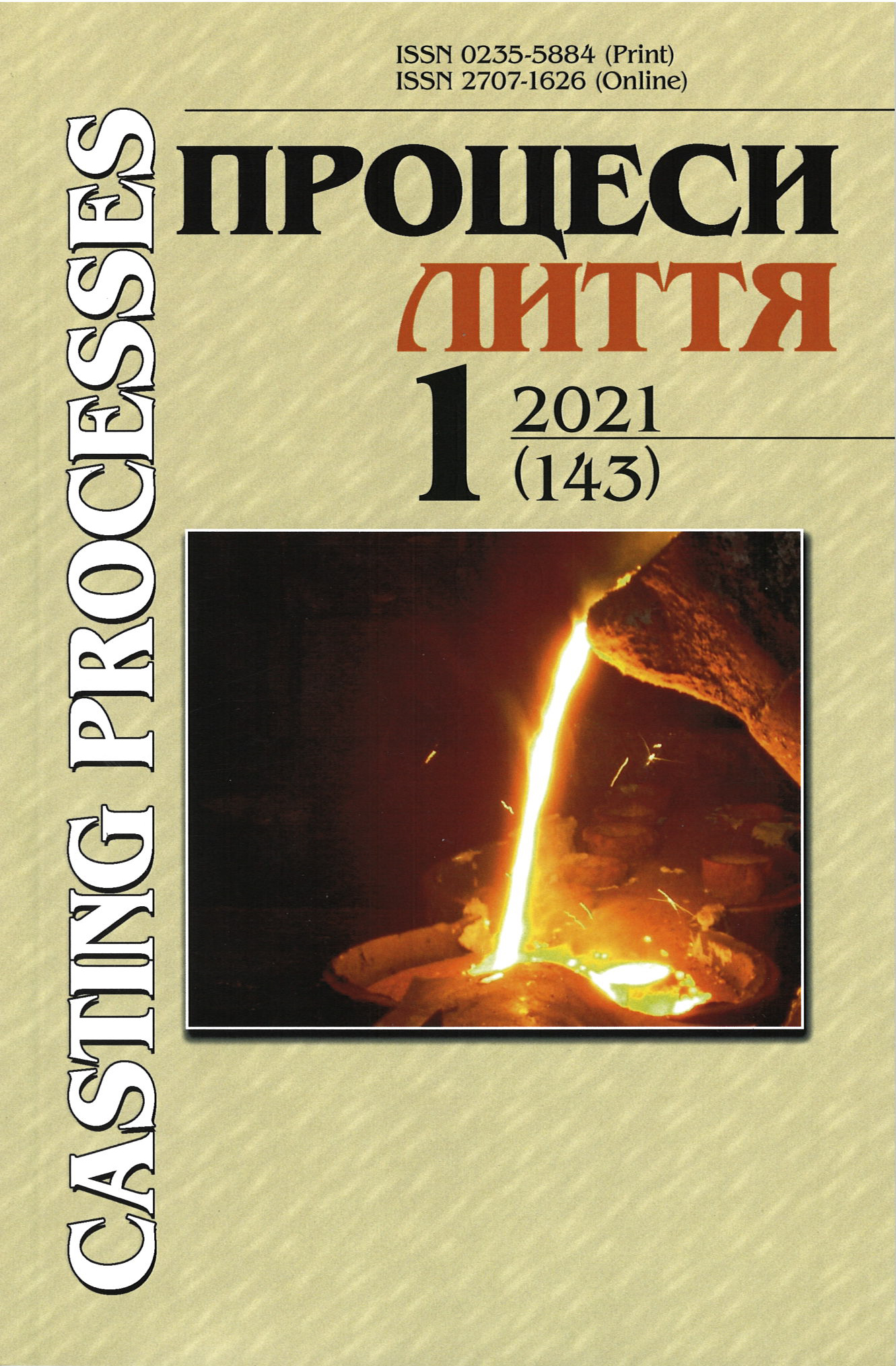
Principles of creep-resistant aluminum alloys development
Processy litʹâ, 2021, Tom 143, №1, p.50-56
DOI:
https://doi.org/10.15407/plit2021.01.050Keywords:
aluminum alloys, heat-resistant aluminum alloys, principles of alloying, new cast materials, materials for work in extreme conditionsAbstract
Received 21.01.2021
UDK 669.018.44:669.715
The work is devoted to monitoring and studying the principles of obtaining creep-resistant Al-based alloys. It is shown that aluminum alloys are constantly expanding their application fields. At the same time, the requirements for a number of aluminum alloys are also growing, which determines their wider use in extreme conditions and, in particular, at elevated temperatures. Examples of parts and details, made of such materials, are used in car engines and special equipment, turbine impellers, parts of heat exchangers and collectors, fittings, cladding elements, and casing parts for aviation and space purposes, etc. Development and production of new creep-resistant materials on the basis of aluminum with the increased level of operational characteristics demands detailed studying of mechanisms and ways maintenance of their optimum structural-phase conditions and finding of effective ways to produce them. The presented work considers the existing methods and principles of efficient creep-resistant aluminum alloys production, among which the greatest
attention is paid to the principles of production of cast alloys, as the most profitable in terms of mass production and economic efficiency. It was shown that the main principles of achieving this goal include: the use of alloying elements (Cr, Mn, Fe, Co, Ni, Cu) and modifiers (Ti, Zr, Mo, Hf), which will promote the formation of stable insoluble phases with low diffusion activity and noticeable cubic
or close to cubic morphology in a metal matrix of the alloy; Creation of eutectic alloys, including silicon-free compositions, which would consist a large proportion of high-temperature phases with favorable morphology; The temperature of the eutectic transformation should be as high as possible; Introduction of technological principles of melts casting and preparation, that are able to effectively grind the structure of the alloy and increase the solubility of insoluble components by creating specific thermodynamic conditions.
References
Gnatush V. A. (2020) Global trends in the market for recycling of waste and scrap of aluminum alloys. Casting processes, no 3, pp. 56–69. [In Ukrainian]
Metal Recycling Factsheet. EuRIC AISBL – Recycling: Bridging Circular Economy & Climate Policy. URL: https://www.euric-aisbl.eu/
Green, J. A. S. (2007) Aluminum Recycling and Processing for Energy Conservation and Sus- tainability. ASM International. P. 198.
Awe S., Seifeddine S., Jarfors A., Lee Y., Dahle, A. (2017) Development Of New Al–Cu–Si Alloys For High Temperature Performance. Advanced Materials Letters, no 8 (6), рр. 695–701.
Pantelakis Sp. et al. (1999) Creep resistance of aluminium alloys for next generation supersonic civil transport aircrafts. Theoretical and applied fracture mechanics, no 31, рр. 31–39.
Richard Rajan, Paul Kah, Belinga Mvola, Jukka Martikainen. (2016) Trends in aluminium alloy development and their joining methods. Reviews on Materials Science, no 4 (44), pp. 383–397.
Kasprzak W., Emadi D., Sahoo M., Aniolek M. (2009) Development of Aluminium alloys for high temperature applications in diesel engines. Materials Science Forum. Vols. 618–619. April 2009, pp. 595–600.
Toshiyuki Tanaka, Yasuki Kamitakahara. (2017) Highly heat-resistant aluminum alloy “KS2000”. Kobelko technology review, no 35, pp. 28–33.
Gorbunov J. (2014) Main Characteristics and future development of aluminum alloys with high dispersion ability of phase of alloying elements. Journal of Siberian Federal University. Engine- ering and Technologies, no 5, pp. 570–578.
R. Molina, P. Amalberto, M. Rosso. (2011) Mechanical characterization of aluminium alloys for high temperature applications. Part 1: Al-Si-Cu alloys. Metallurgical science and technology. Vol. 29–1, pp. 5–15.
R. Molina, P. Amalberto, M. Rosso. (2011) Mechanical characterization of aluminium alloys for high temperature applications. Part 2: Al–Si–Cu alloys. Metallurgical science and technology. Vol. 29–2, pp. 5–13.
Vojtech D. (2010) Challenges for research and development of new aluminium slloys. METALURGIJA. no 49 (3), pp. 181–185.
Rakhmanov J., Timelli G., Bonollo F. (2016) The effect transition elements on high-temperature mechanical properties of Al–Si foundry alloys – A review. Advanced engineering materials. no 7, pp. 1096–1105.
Chang-Yeol Jeong. (2013) High temperature mechanical properties of Al–Si–Mg–(Cu) alloys for automotive cylinder heads. Materials transactions. Vol. 54, no 4, pp. 588–594.
Sims Z.C. et al. (2016) Cerium-Based, Intermetallic-Strengthened Aluminum Casting Alloy: High-Volume Co-product Development. JOM. Vol. 68, pp. 1940–1947.
Keith E. Knipling, David C. Dunand, David N. Seidman. (2006) Creteria for development castable, creep-resistant aluminium-based alloys – A review. Z. Metallkd, no 97, pp. 246–265.
Inoue А. et al. (2015) Development and application of highly functional Al-based materials by use of metastable phases. Materials research, no 18 (6), pp. 1414–1425.
Robinson J. S., Cudd R. L., Evans J. T. (2003) Creep resistant aluminium alloys and their appli- cations. Materials Science and Technology. Vol. 19, pp. 143–155.
Inoue A., Onoue K., Masumoto T. (1994) Microstructure and properties of bulky Al84Ni10Ce alloys with amorphous surface layer prepared by high-pressure die casting. Materials Transac- tions, JIM, no 35 (11), pp. 808–813.
Weiss D. (2018) Development and Casting of High Cerium Content Aluminum Alloys. Global Casting Magazine, no 2, pp. 22–27.
Pozdniakov A. V., Lotfy A., Qadir A., Zo 22–27. lotorevskiy V. S. (2016) Effect of the B4C content on the structure and thermal expansion coefficient of the Al–5% Cu alloy-based metal-matrix composite material. The Physics of Metals and Metallography. Vol. 117. Issue 8, pp.783–788.
Lotfy A. et al. (2018) Novel preparation of Al–5%Cu / BN and Si3N4 composites with analyzing mi- crostructure, thermal and mechanical properties. Materials Characterization. Vol. 136, pp. 144–151.
Tian W.S., Zhao Q.L., Zhang Q.Q. (2017) Superior creep resistance of 0.3 wt.% nano-sized TiCp/ Al-Cu composite. Mater. Sci. Eng. 2017. A 700. Pp. 42–48
Bo Lin et al. (2019) Improved creep resistance of Al–Cu–Mn–Fe–Ni alloys through squeeze casting. Materials Characterization. Vol. 158, pp. 1–7.
Amenova A., Belov N., Smagulov D., Toleuova А. (2014) Perspective high strength aluminium alloys of new generation based on Al–Ni–Mn–Fe–Si–Zr system. Materials Research Innova- tions. Vol. 18, рр. 50–53.
Martinez-Sanchez R. et al. (2016) Evolution of Microstructure in Al-Si-Cu System Modified with a Transition Element Addition and its Effect on Hardness. Materials research. Vol 19. Supl. 1, pp. 59–66.
Czerwinski F. (2020) Thermal Stability of Aluminum Alloys – A Review. Materials, no 13 (15), pp. 1–49.
Bala G. Narasimha, Vamsi M. Krishna, Dr. Antony M. Xavior. (2013) A Review on Processing of Particulate Metal Matrix Composites and its Properties. International Journal of Applied Engi- neering Research. Vol 8, no 6, p. 115–130.
Nembach E. (1997) Particles strenghthening of metals and alloys. New York. John Wiley and Sons. 997 p.
Kumar K. S. (1990) Ternary intermetallics in aluminium refractory-metal X systems (X = V, Cr, Mn, Fe, Co, Ni, Cu, Zn). Intermetallic Materials Review. No 35 (6), pp. 293–327.
Nakayama Y., Mabuchi H. (1993) Formation of ternary L12 compounds in Al3Ti-base alloys. Intermetallics. No 1 (1), pp. 41–48
Takeda M., Kikuchi T. Makihara S. (1999) Stabilizing effect of third element on an L12–Al3Ti compound. Material Science Letters. No 18 (8), pp. 631–634.
Humphreys F. J., Hirsch P. B. (1978) Work-hardening and recovery of dispersion hardened alloys. Phil. Mag. Vol. 34, pp. 373–399.
Glazoff M. et al. (2019) Casting Aluminum Alloys: Their Physical and Mechanical Metallurgy. 2nd Edition. Butterworth-Heinemann. 554 p.
Downloads
Published
How to Cite
Issue
Section
License
Copyright (c) 2021 А. В. Нарівський, М. М. Ворон, М. А. Фон Прусс, В. В. Перехода, О. В. Чистяков

This work is licensed under a Creative Commons Attribution 4.0 International License.