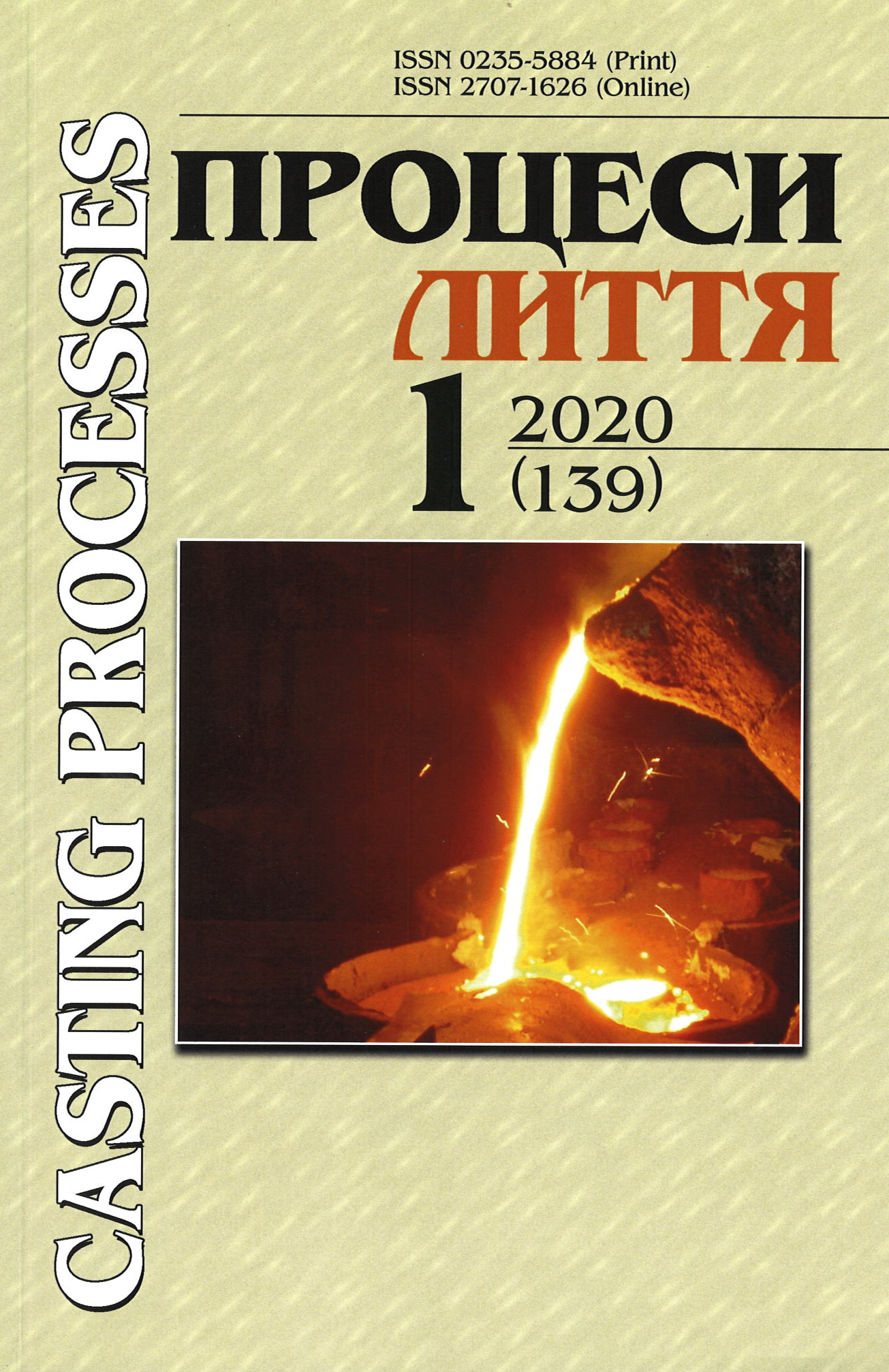
Methods of Cooling Castings in the Design of the LTO Process, Complementing the Technology of Casting and Heat Treatment
Processy litʹâ, 2020, Tom 139, №1, p.42-53
DOI:
https://doi.org/10.15407/plit2020.01.042Keywords:
cooling of castings, heat treatment, iron-carbon alloys, isothermal hardening, ductile iron, ADI, LTO process, ferrite, ausferriteAbstract
Received 06.11.2019
UDK 621.74.02; 621.74.041; 669.13 (03)
In foundry, in the development of methods for controlled cooling of castings after their solidification in sand mold, a combination of casting with heat treatment (HT), which can be called the LTO process, is proposed. The conditions for the development of the LTO process for castings from iron-carbon alloys with medium and high carbon content are considered. PTIMA of the National Academy of Sciences of Ukraine for 2018–2019 obtained a number of patents of Ukraine for methods of complementing casting and HT as varieties of the LTO process, in which Austempering of castings was used. The most convenient for LTO it is casting process in vacuum evacuated sand molds, the sand of which is easily poured out after the end of evacuation, without hindering the removal of the hot casting from the mold. For cases of adhesion of foundry paint to the surface of the casting, sand residues or local areas of the burn, especially for large castings, a method of hardening by supplying an air-sand mixture to a hot casting is proposed, as in sandblasting. A brief review of a number of works published in recent years on the influence of variable technological characteristics, mechanical properties, and microstructure on the manufacturing process of two-phase ductile cast iron (DI) type ADI is performed. Currently, there has been a significant increase in research and development around the world devoted to the production of biphasic and multiphase microand macroinhomogeneous structures containing ferrite, ausferite, bainite, martensite, carbides, carbonitrides, intermetallic compounds, and combinations thereof. Due to this, the properties of known iron-carbon alloys subjected to isothermal quenching according to traditional schemes are improved. Isothermally hardened ADI cast iron with the possibility of controlled introduction of free (proeutectoid) ferrite into the metal matrix improves the machinability of castings, which gives grounds for including the technology of such ADI in the LTO process along with other well-known methods.
References
Najdek, V. L., Gavrilyuk, V. P., Neizhko, I. G. (2008). Bainitic ductile iron. К., 140 p. [in Russian].
Gаbrisovа, Z., Brusilovа, A. (2019) Heat treatment: tutorials. Bratislava: SPEKTRUM STU, 134 p. [in Slovak].
Zharskij, I. M. et al. (2015) Material Science: a training manual. Minsk: Vyshejshaya shkola, 557 p. [in Russian].
Doroshenko, V. S., Kalyuzhnij, P. B. (2019) The concept of cooling castings using cryotechnology, new bulk materials and casting methods. Metall i lite Ukrainy, no. 5-6, pp. 33-39 [in Russian].
Global Casting Production Expands (2019). Global Casting Magazine, Vol. 9, no. 1, pp. 28-30 [in. English].
Dibrov, I. Tendencies of development in the Russian foundry industry. 30.05.2019. URL: https://www.foundry-planet.com/news/corporate-news/detail-view/tendencies-of-dev. russian-foundry-industry-2019/. [in. English].
Doroshenko, V. S. (2017) Possibilities of casting of nodular cast iron by gasifying models with isothermal hardening of castings. Litejnoe proizvodstvo, no. 11, pp. 7-14 [in Russian].
Atzori, B., Meneghetti, G., Ricotta, M. (2012) A compatible method to summarise the Low- and High-Cycle fatigue test results of ductile irons and structural steel. Workshop IGF, Forni di Sopra (UD), Italia, 1-3 marzo, pp. 153-166 [in English].
Dudeckaya, L. P. et al. (2002) Heat treatment on the bainitic structure of cast iron parts. Lite i metallurgiya. no. 1, pp. 45-49 [in English].
Cekic, O. E., Rajnovic, D., Sidjanin, L. et al. (2019) Dual Phase Austempered Ductile Iron - The Material Revolution and Its Engineering Applications. Computational and Experimental Approaches in Materials Science and Engineering, Proceedings of the Int. Conf. of Experimental and Numerical Investigations and New Technologies, CNNTech. September. pp. 22-38 [in. English].
Malinov, L. S. (2019) Processing technologies that implement the concept of producing in steels and cast irons a multiphase micro- and macro-heterogeneous structure with metastable austenite to increase their properties. Universitetskaya nauka - 2019: Mezhdunar. nauchno-tehn. konf.: tez. dokl. GVUZ «PGTU». Mariupol: PGTU, pp. 99-101 [in Russian].
Geller, Yu. A., Rahshtadt, A. G. (1989) Material science. Moscow.: Metallurgiya, 456 p. [in English].
Harding, R. A. (2007) The production, properties and automotive applications of austempered ductile iron. Kovove Mater. 45, pp. 1-16 [in English].
Downloads
Published
How to Cite
Issue
Section
License
Copyright (c) 2020 В. С. Дорошенко

This work is licensed under a Creative Commons Attribution 4.0 International License.